
Our Nation's First Flag
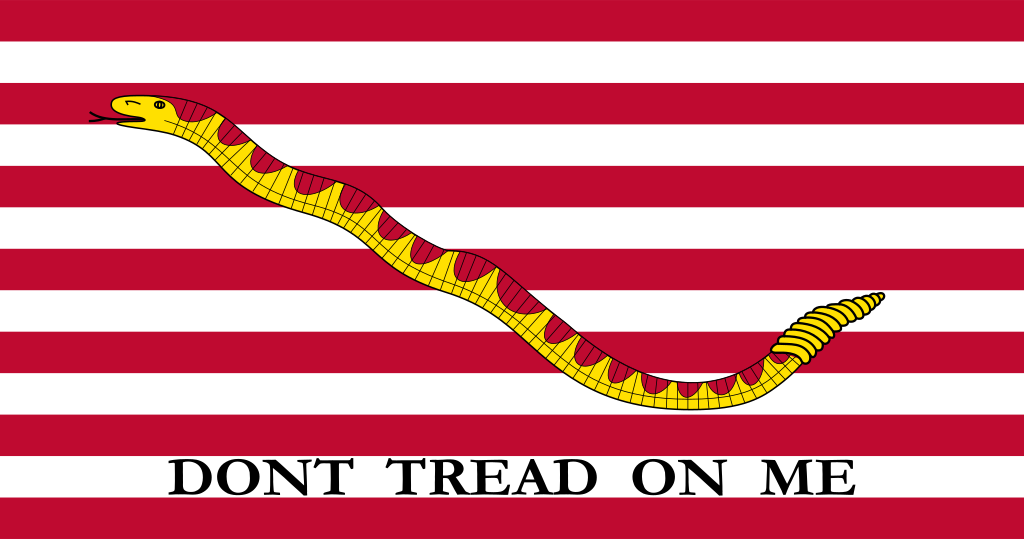
First Navy Jack
FLAG HISTORY
A flag born in revolution
1775
American Revolution
There is a widespread belief among historians that ships of the Continental Navy wore a jack flag consisting of alternating red and white stripes, having the image of a rattlesnake stretched out across it, with the motto "Don't Tread on Me." Conceived by Commodore Hopkins in 1775. Commodore Hopkins ordered the flag to be used as a signal to engage the enemy. This in essence makes the First Navy Jack our first national flag to be worn in battle. Ordinarily a jack flag is used only when the ship is at anchor and displayed from a short jack staff. “Don’t Tread on Me” was introduced during the Revolutionary War, the meaning behind the phrase is simple in that a snake doesn’t strike until provoked. Hence John Paul Jones when asked to surrender his vessel replied "I have not yet begun to fight". In the end he won the battle.
1975
Americas' Bicentennial Commemoration
By an instruction dated 1 August 1975 (SECNAV Instruction 10520.3) the Secretary of the Navy directed the use of the rattlesnake jack in place of the union jack during the period 13 October 1975 (the bicentennial of the legislation that created the Continental Navy, which the Navy recognizes as the Navy's birthday), and 31 December 1976. The first flag was given to Commodore Clayton Saunders and flown on the USS Rushmore (LSD 47). During the ceremony Saunders said,"this flag represents a renewed commitment by the Navy to our first principles, to secure freedom both at home and abroad." The message was not about conquest. It was not about domination. It was not about looking for a fight. It was a warning. Beginning in 1977 the ship with the longest period of active service was to display the First Navy Jack until decommissioned or inactive. The flag is then passed to the next ship with the longest period of active service, with the exception of the USS CONSTITUTION.
September, 11, 2011
By an instruction dated 31 May 2002 (SECNAV Instruction 10520.6), the Secretary of the Navy directed the use of the rattlesnake jack in place of the union jack for the duration of the Global War on Terrorism.
Symbolism
The First Navy Jack is one of America’s earliest symbols of unity, resistance, and self defense. The rattlesnake represents a people who did not seek conflict, but would defend themselves when pushed too far.
The Significance of the First Navy Jack Flag Today
Recently, the first Navy jack flag has been used as a patch on the uniforms of members of the U.S. Army and Navy. Typically, this patch is worn on the right arm, below the American Flag.
Why a rattlesnake?
Native to America, rattlesnakes produce a loud rattling noise when threatened. Unless they are provoked or stepped on, rattlers will not attack. They do not surrender in an attack, and with teeth like hypodermic needles and debilitating, toxic venom, they are truly dangerous animals to entice. Using the rattlesnake image on a flag shows unity and power. The image in essence is meant as a warning that America will attack when provoked and won't give up, just like the rattlesnake.
2026
pavititern.org
Here at pavititern.org, the Navy Jack speaks to a deeper truth. Veterans understand what it means to stand watch. They understand restraint. They understand warning. They understand the cost of being sent into conflict and then being left to carry the weight after coming home. This is the truth pavititern.org stands with; Veterans do not need propaganda. They need truth. They need support. They need community. They need a place where their stories are not only heard, but honored. The Navy Jack reminds us that a warning is not hatred. A boundary is not aggression. Standing firm is not the same as seeking war.The Navy Jack is not just a flag. It is a reminder that freedom must be defended, it should never be twisted into propaganda.
Truth
Today our First Navy Jack is worn proudly by the USS CONSTITUTION, Boston, MA. She is the oldest commissioned warship in the world. This ship is home ported in Boston, MA. The American Revolution began in Boston Harbor, December 16 1773. The residents of Boston refused to pay the tax on the English tea into the harbor to protest taxation without representation. Today the people are taxed unfairly and the big corporations pay little if any tax. Our servicemen are fighting in countries all over the world not to promote democracy but to capture that countries resources. Our Veterans today are committing suicide at a rate of 18 a day since the attack of 911. This is according to our Veterans Administration.
Our Nation's Propaganda Flag
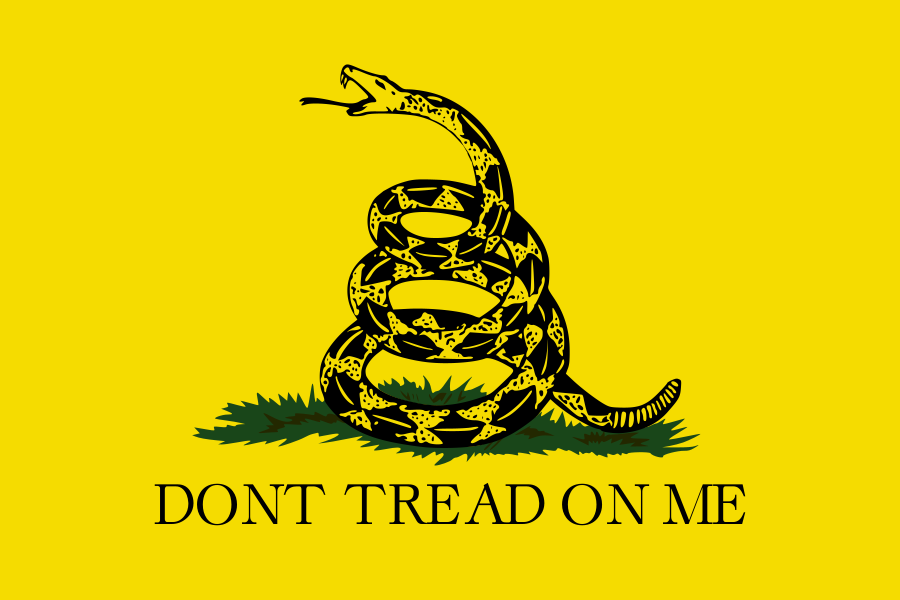
Gadsden Flag
FLAG HISTORY
A Flag born to dominate
The Gadsden flag uses the same words, “Don’t Tread on Me,” but its coiled rattlesnake presents a more aggressive image. Over time, that image has often been used to project confrontation, intimidation, and domination of others. When a symbol that once warned against oppression is used to frighten or dominate those seen as vulnerable, it begins to resemble the bully it was meant to resist. Unlike the First Navy Jack the Gadsden never came to prominence in the revolutionary war other than to be carried into battle in the colony of South Carolina, Brigadier General Gadsdens' home colony. It reared its ugly head and came to prominence in the fifteen slave states during the American Civil War.
1861
Civil War Begins,Boston, MA
On April 18, 1861, six days after the opening shots of the Civil War, the Philadelphia Inquirer described a “great sensation” in Boston.
A “strange craft” had appeared in the harbor: a merchant vessel from Georgia that flew “a white flag, having on it the emblem of a rattlesnake, with the motto underneath ‘Don’t tread on Me!’ and also below this, fifteen stars, representing the fifteen slave States. This was the beginning of the Gadsdens' flag climb to prominence in the slave states.
According to the Inquirer, as soon as the ship’s captain saw the mob, he lowered his flag and hoisted the Stars and Stripes, at which point “‘The Rattlesnake’ was eagerly seized and trampled upon by the multitude, and then torn completely to tatters.”
The episode comes from a chapter that’s usually overlooked in the history of the Gadsden flag, which has reemerged as a provocative antigovernmental symbol.
A Confederate Flag is Born
The Gadsden flag was not the official “Flag of the Confederacy,” as the Alabama Beacon called it, but several newspapers described it in those terms. In September 1861, when the Cincinnati Daily Press predicted that “Jeff Davis & Co.” might soon invade Maryland and Delaware, it stated that “the coiled snake, and ‘don’t tread on me’ will be sent at the head of the invaders".
The episode comes from a chapter that’s usually overlooked in the history of the Gadsden flag, which has reemerged as a provocative antigovernmental symbol. Republican lawmakers from the tea party movement claimed the flag in their fight against federal overreach. As images of stomped, stabbed and eaten snakes proliferated in Union illustrations, Confederates gradually relinquished their serpents. Instead, they embraced the “Southern Cross” battle flag, a symbol that has persisted to this day.
The Eagle versus the snake
When Confederates reverted to the rattler, Unionists countered with scenes of eagles devouring snakes, evoking mythological and religious battles between good and evil. “The Eagle shall bear the Rattlesnake in his beak and rend him with his talons,” declared one especially gory illustration for Union envelopes.
The Boston poet Mary Webb invoked the eagle-snake confrontation in her 1861 poem “Our Massachusetts Dead,” in which she mourned Northern losses: “Our eagle in the serpent’s coil !/But (bruising, soon, the serpent’s head).
2007
Republicans Formed tea party movement
Republican lawmakers from the tea party movement claimed the Gadsden flag in their fight against federal overreach. In 2008, Republicans gained 63 seats in our house of representatives.
2017
August,11 & 12
Charlottesville, Virginia, Unite The Right Rally
Here the Gadsden Flag and the Confederate Flag were reunited. The rally consisted of all manner of far right groups: Neo Nazis, Fascists, and Ku Klux Klan. All kinds of antisemitic groups participated. They also carried weapons and symbols like the Nazi flag, the Confederate flag, the Ku Klux Klan and the Gadsden flags were carried through the streets of Charlottesville during the two day rally.
2021
Insurrection
US Capitol January, 6, 2021
At the Capitol riot, the Confederate flag and the Gadsden flag again flew side-by-side as the insurrectionists stormed our House of Representatives.
Truth
When the language of defiance becomes the policy of a bully, the cost is often paid by those sent to carry it out. The empty boots and American flags represent veterans who never came home from combat, as well as those who returned carrying wounds that were not always visible and later died by suicide.
 Veteran's Digest: Real Stories From Those Who Carry the Weight