
My life story begins in Massachusetts in March of 1942. Born in the Town of Mansfield, a little over 3 months after the Japanese attack on Pearl Harbor. My life in the 40's 50's and 60's revolved around WWII. My neighbor across the street had served in both WWII and Korea. Growing up my mother forbade me to ever go into the Five & Dime store because the owner was charging two dollars for diapers during the war. I had to wear rags on my bottom. A neighbor down the street from me had lost their only son when the USS Hornet was sunk in the Battle of the Santa Cruz Islands on October 26, 1942. There was a picture of him on his ship in their sunroom. As a young teenage boy, I used to enjoy sitting in their sunroom after school talking with them about their son who had made the ultimate sacrifice for his country. They were so proud of him, yet so sad after losing their only son to the war.
When I wasn't building hot rods, or houses I was shoveling cow manure at Turners Farm in West Mansfield. Before the hot rods, it was a quick pedal bike ride to the East Mansfield greenhouses where I learned how to grow tomatoes and cucumbers organically. They were sold in the spring on pushcarts at the Haymarket square in Boston. Every Tuesday was horse manure day at the greenhouses. We would pile in the pickup truck and head to Wheaton College in Norton which was a private "girls only school". Wow, was it ever a hot experience for maturing thirteen year old boys to shovel the horse manure into the truck while the girls rode their horses in the nearby arena. They rode with English saddles, knee high riding boots, and fancy outfits with helmets. Posting on their horses, their hair as well as breasts bouncing up and down as they jogged the horses around the arena. In the hot summer months, we would enter the large brick boilers that kept the greenhouses warm for the winter & spring growing seasons. They would be caked with slag from the oil fires. It was nice and cool inside the cavernous boilers. Then came the bushel baskets of the horse manure. We had piled the manure outside the greenhouses to cure. Sitting outside all winter small red piss ants had made their home inside the manure. We disturbed them when we shoveled the manure into bushel baskets for distribution into the greenhouses. On hot summer days clad only in dungaree cutoff shorts we carried bushel baskets into the greenhouses. The ants would bite us unmercifully on our bare skin, bringing back memories of the pretty girls bouncing up and down. At the end of our day, the Canoe River in the back of the greenhouses welcomed us for a long skinny dipping swim in its clear cool waters. After fertilizing the houses, we would fire up the newly de-caked boilers to test them and sterilize the greenhouses with steam hoses.
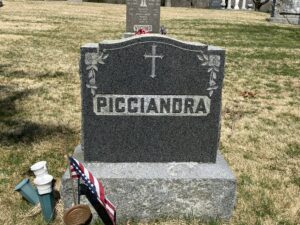
St. Mary's Cemetery was right across the street from the greenhouses. Here my granfather was laid to rest in the front row just a young man of 58 years. My grandfather was the town butcher. He passed away suddenly in 1928 from blood poisoning he contracted while butchering meat and fish to feed people. There was no penicillin to cure blood poisoning in 1928. He left his wife and nine children on their own at the begining of the Great Depression. He was only fifty eight years old, a legal immigrant, but still an Italian citizen. At this point in my life I am ready to return to my homeland in Cesano Di Roma where the Picciandra family tomb is also in the front row.
Before hot rods most nights were spent hanging out with the boys on Main Street, either on the common, at the train station or on the steps of Sannie's Department Store always harassing the local constables. Friday nights were spent dancing at the Record Hop at the old town hall on the 2nd floor. A few years later on Wednesday night, we would pile into our hot rods and head to the North Attleboro Record Hop. It seemed like there was almost as much fighting as dancing and we enjoyed both. After the dance, we would jump in our hot rods head to Jolly Cholly's on Rt 1, in North Attleboro for frappes and sometimes more fights.. Saturday nights were reserved for the stock car races at the Norwood Stock Car Track. We would load the cars on a flat bed truck at the Schultz's Farm in West Mansfield. I loved those days as a fifteen year old with grease on my face to hide my age being in the pits keeping the cars running after minor crashes or engine trouble. I knew all the drivers by name, the pits is where I belonged. My time at high school was spent in shop class building hot rod cars or motor cycles. I would skip a lot of my woodworking classes because my wood shop teacher, Mr. Eastman, had lost his thumb to a table saw blade. I figured that if this could happen to my teacher what might happen to me. The metal shop was my home. I spent a lot of time in the library reading books on the war that I was born into. I didn't care too much for English or social studies so I would bring my library books to class and prop them up on my desk behind my textbooks to read during class.
My father was a WWII Navy veteran. All my uncles on both sides of my family served in WWII in all branches of the armed services. All of them survived, though their lives were changed forever. None of them including my dad ever spoke of their wartime service. A bald headed man would sit in my fathers barber shop often. His nickname was "Mr Clean". I learned later he was with my father in Norfolk VA in a shipping and receiving barracks waiting for a ship assignment. One drunken night my dad was thrown in the brig for 7 days, when he returned his friend was gone only to return a week later after being rescued from a torepedoed ship. He had lost his hair and it never grew back. One of my uncles would walk to work, come home and sit in a rocking chair, not talking, just staring into empty space. My uncle Squinky Amici (nickname for ICE protection), a Marine who fought in the bloody battles on the islands of Guadalcanal and IwoJima. After the war, he became a mortician because he didn't want to see any more bloated bodies. He told me this story after I came home from Vietnam. My cousin by marriage, Robert Tighe, was General George S. Patten's stenographer on April 11, 1945 when the 6th Armored Division of Patton's Third Army entered Buchenwald. He became a school teacher in Mansfield. His life was devoted to educating people about the horrors and atrocities of Hitler he had witnessed during WWII. The pump was primed for JFK's 1958 visit to Mansfield High School.
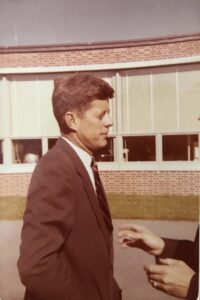 In September of 1958 Senator Kennedy arrived at Mansfield High School to talk with students about service to their country. Not just service in the military but service in government as well as civil service. Anything that would make our country a better place to live. His short speech in our small auditorium was resoundingly meaningful and awe-inspiring to this sixteen year old sophomore Industrial Arts Major. I also played the trumpet in the Mansfield High School Marching Band and the baritone in the concert band. Our auditorium had an orchestra pit right below the stage. What a thrill it was to be playing the baritone in the concert band right next to this charismatic man. The band played George Washington's March for JFK'S visit and he loved it so much he shook our hands when he left.
The Mansfield High School marching band, along with the color guard and drill team comprised one hundred fifty students which is a remarkable feat for such a small school. I began playing the trumpet in the 3rd grade. In my 4th grade, Jim Gallo came to town as our new music teacher. He created this rag tag bunch of about 30 school kids to march in the so called High Scool Band, I say "so called" because most of us were in the lower grades. We wore black and white home made uniforms with black bow ties and shoes. We had two shoe shine boys marching in the rear of the band carrying shoe shine boxes, prepared to polish any scuffs to our shoes. It was quite a sight to see these kids marching in our local parades along with home made floats, WWII veterans, firemen, police officers and assorted dignitaries. A few years later, the band members stood on the street corners holding quart ice cream containers begging for money for new uniforms. A year later, we were putting on shows at the football field in our fancy new uniforms complete with plumed hats, buttoned down uniform coats and white buck shoes. We marched and marched, Diamond Jim would have us march to promote the new cars coming out, anything to show us off. Every opportunity he had to showcase his marching band. Later the band would march in New York and cross the ocean to Ireland to perform there.
Little did I know then that on the day of JFK's assassination, November 22, 1963, I would be an Aviation Machinist Mate 2nd class on board the USS CORAL SEA, one day out of San Francisco, returning from my second tour of duty in the Gulf of Tonkin. In October 1963 JFK sent Secretary of Defense Robert Mc Namara and Joint Chief of Staff General Maxwell D. Taylor to Vietnam, to review the situation. Upon their return JFK called Vietnam a "quagmire" He stated publicly we should not get involved in Vietnam. One month later he was assassinated in Dallas Texas. Life has not been the same since this great man was taken from us.
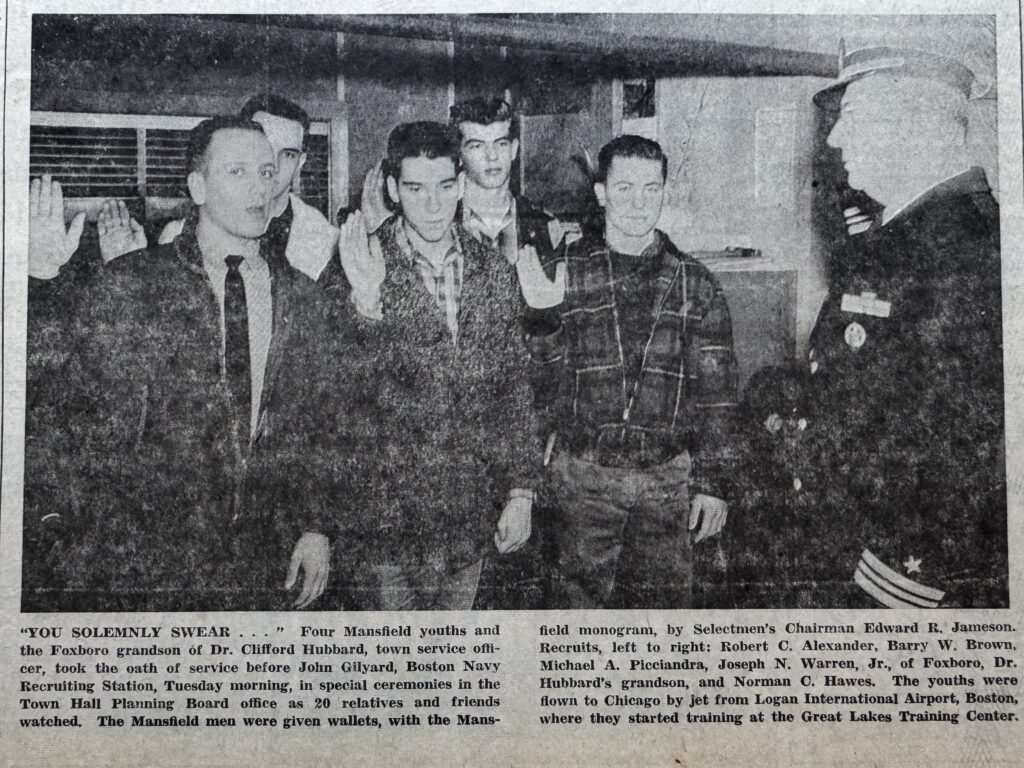
 In October, 1960 the recruiters from all branches of the military came to Mansfield High School offering guarantees of specialized training schools of our choice to all our graduating seniors. The big plus was that, if we completed our mid-year exams, we would be given our diplomas in June. It was a big plus for our teachers also as they would not have to tolerate these wise guys disturbing their classrooms. We all passed midyear exams with flying colors. I was most interested in the Air Force. Just thinking about a jet engine got me excited. After talking with the recruiters from the Air Force ,and Navy. I found the Air Force highly specialized the engine into seperate specilties. I was interested in learning everything about a jet engine. I decided on the Navy where we would be taught the entire engine from intake to exhaust and fuel systems. The Navy would have less than one hundred men to keep a squadron of twelve aircraft. in the air, whereas the Air Force would require more than six hundred men for the same size aircraft. In thier barracks they slept four men to a room whereas the Navy provided us with tiny lockers, three high bunks, with thirty six men in a small compartment with one card table and four chairs. I signed on with the Navy as a High School Airman Recruit, guaranteed a Class A Navy school on jet engines. On January 31, 1961, four Mansfield high school seniors and one from neighboring town of Foxboro were sworn into the United States Navy in the old Mansfield Town Hall. On that day, I swore an oath to uphold the Constituition of the United States of America. In that moment, president John F. Kennedy became my Commander in Chief. The four Mansfield enlistees comprised the largest contingent to enter any branch of the military since WWII. We were put on a train to Boston, sworn in again along with a hundred other recruits put on an airplane for Chicago, IL. From there we rode on an old steam train that had coal stoves for heat. After the train ride it was busses to the gates of the Great Lakes Naval Training Center. Once we walked inside the gates it was about 0200 hours. Our new life was about to begin, never to be forgotten. We were placed in a drill hall and told to sleep on the floor. At about 0400 hours they woke us up by banging thier wooden batons inside metal trash cans. They lined us up haphazardly and marched us in minus twenty degree weather to the chow hall. After 15 minutes to chow down we were marched together to a building. We had to fill out and sign tons of paperwork. One of the many questions asked was do you play a musical intrument? I was advised by a fellow MHS bandmember home on leave from navy bootchamp to say yes! Consequently I played the bugle in the Navy Drum & Bugle band after our two weeks of initial training in nice warm drill halls while the others marched outside in tempertures down to forty degrees below zero.
After the paperwork, we had us undress for our body inspection. We took off all our clothes, packing them to send home to our parents. Next came the number, they gave each one of us our number while we were naked. We were instructed to remember this number if we wanted clothes, food or a place to sleep. We were told to shout out our number out to each corpsman when he gave us a shot. We lined up single file with corpsman on botheach side poking us with needles, the cacophony of sounds eminating from the one hundred recruits was unbelivable, whith each recruit shouting as loud as he could, making sure the corpsman heard his number. Then it was off to get our seabag and fill it with our new Navy uniforms. First we would have to give the man at the window our new number or he would not give you clothes. From there we were marched haphazardly to the barracks with our clothes and bedding. Once assigned a bunk we had to repeat the number, then we were given pieces of paper with diagrams on how to fold our clothes and make our bunk. A diagram for clothes in the tiny locker and one for our seabag. The curious thing we recieved with our clothes was short pieces of small diameter rope which were called "clothes stops". We later found out that after washing our clothes in the sink we would use the clothes stops to prevent our clothes from hitting the ground! We also used them to learn how to tie knots with them. The seabag is our traveling suitcase, everything we owned would have to be folded properly or it wouldnt fit. Every recruit was lamenting about how this was an impossible task but we all learned how to do it. We also had a diagram on how to make up our bunk beds. About that time the Bosn Mate entered the barracks rattled the trash can and ordered us outside in our brand new uniforms. He formed us in rows in alphabetical order. On the first day of Boot Camp, Feburary 1, 1961, it was about twenty degrees below Zero outside, with a blustery northwest wind coming off the nearby Great Lakes. The Bosn Mate called the cadence as we attempted to march us to the chow hall. We stepped off to his cadence which came naturally to me having spent so much time in maching formations on the football field and on the streets in parades. Over the years I had come to enjoy marching. I still do today humming to myself the same tunes we used to play while marching.Upon arrival we were lined up alphabetically single file for entering the chow hall. Once again and for the next eight weeks you had to give your number to the Bosn Mate as you entered the chow hall. This 1st class Bosn had served in WWII in the pPacific. He had tatttoos everywhere you could see, even his face. The cuffs of his sleeves showed dragons and other symbols embrodered in colorful patterns. On one one cheek he had "Fuck the Japs", on the other he had a dagger. Tattoos may be an everyday sight today but in 1961 it was not. My mother told me when I chose to join the Navy not to get any tattoos and if I did not to come home. Needless to say I never got a tattoo. After chow it was back in formation back to the drill hall to get our stripes. Mine was a single green stripe which signified I was now officially an Airman Recruit in the United States Navy. My entry into the Brown Shoe Navy would begin after graduation from Class A school in Memphis TN, just a few short months away. I would wear brown shoes with suction cups that would help us cling to the flight deck. Only airdale Navy were issued brown shoes.
My father was forced to quit school at thirteen years old when his father died. He was the oldest boy of nine children so it was up to him to be the man in the family. Two of my aunts were older than him, together they kept the family together the best they could during the depression. My father was lining children in the school yard for hair cuts costing three cents to a nickle each head. When my June graduation came around, my dad went up on the auditorium stage to get my high school diploma. I was the first member of my family to graduate from high school. Here was my father a WWII veteran going up on the stage to get my diploma! The same stage that JFK had given his speech that so inspired me.
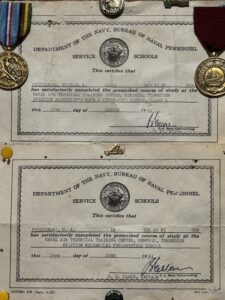
After twenty two weeks of training at the Naval Air Technical Training School in Memphis TN. on June 23, 1961, I was awarded a Certificate of Aviation Mechanical Fundamentals, on August 10 1961, I was awarded a Certificate of Aviation Machinist Mate Jet Engines. After a short visit with family and friends, my orders were to report to the Officer of the Day at Naval Air Station, Lemoore California.
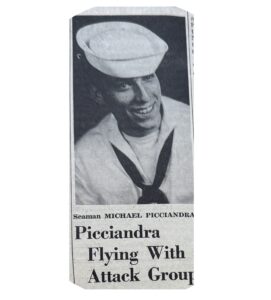
After eight weeks of training in an A4D squadron at the Naval Air Station Lemoore CA, on November 16, 1961, I officially became a member of the "Silver Foxes", Attack Squadron VA-155 part of Carrier Air Group Fifteen "CAG-15".
I had arrived in Fresno, CA via Greyhound bus on a very hot August day. The very dry heat of the desert was a stifling hundred degrees or more. I had my entire life in the seabag I carried on my shoulder. On that day there were no buses to base, so my options were hitch-hiking or taxi to the base. I choose hitch-hiking.
Naval Air Station Lemoore California is in the middle of nowhere surrounded by farm land, equal distance to or from San Fransisco or Los Angeles. The base was enormous, encompassing fifty eight square miles of desert. Our barracks were six miles from the aircraft hangers. The runways over six miles long were the longest in the world. Once there, I entered a training squadron in the operation of the Douglas designed A4D Skyhawk. The plane was powered by a J65 Westinghouse engine. The A4D was nicknamed the"Bantam Bomber". After eight weeks of training, I was assigned to attack squadron VA 155, "The Silver Foxes". Month long carrier qualifications came next onboard USS CORAL SEA CVA- 43 with a short "port of call" in Seattle WA. This was my first experience in a big city as a sailor in uniform. No civillians clothes were allowed onboard the ship. Back in school we had practiced what a flight deck would be like in the drill halls. Now this was the real thing. Nothing could prepare us for the chaos that followed onboard this floating airfield. The attack aircraft carrier, Coral Sea CVA-43, carried four thousand men and approximately seventy five aircraft. Twenty four of her aircraft were propeller driven. The big challenge was finding your way around this massive ship with so many ladders leading to so many decks, compartments, all with strange names. Then came flight operations which was filled with unseen and unknown dangers lurking everywhere. It was intimidating and awsome at the same time!
Being one of the newbies in the squadron I was assigned to galley duty scrubbing pots and pans. The chow hall was open twenty two hours a day. It closed from 2000 hours to 2200 hours for cleanup. After two days of watching the water in the scullery sink sloshing back and forth, I found my way up to the line shack under the flight deck. I approached the 1st class petty officer in charge. I asked him why had the Navy spent all that time and money for schooling and training me only to send me to the galley to scrub pots and pans. He asked me if I thought I was ready to come to the line crew, I answered "hell yes". The next day I was reassigned to the line crew. Little did I know what awaited me. My first job was to relieve plane captains while they ate or caught a kink (short sleep). The aircraft could not be left unattended anytime during flight operations. A plane captains job was one of the most important on the ship. without the airplane we had no purpose nor could we defend our selves. Yes every man on the ship had a purpose and job but without aircraft plane captain no planes could leave the ship. The plane captain would be assigned an aircraft that he had to maintain in combat readiness 24/7. Anytime day or night during flight operations he had to be with his plane so he could ride the brakes at the direction of plane director. Prior to his plane being moved he had to undo the chains that tied his plane to the deck. Once moved it was his responsibility to secure the plane with tie down chains. The plane pushers would put chocks under the wheels anlong with three chain tie downs that were hanging from the catapult hook. The plane captain would install five more to secure the plane at the end of flight operations. The plane captain oversaw and documented all fuel, oil, liquid oxygen and munitions that went onto his plane. Before his plane was allowed to fly he had to put his signature in the log book that stated the plane was ready to fly a mission. He also listed, fuel, liquid oxygen and munitions and added them to the gross weight of his plane for that sortie in the log book. He also added this number with a grease pencil to the nose wheel well door. This was done in order for the catapult officer to dial up the right amount of steam to get his aircraft off the deck. A cold cat shot would mean certain death for the pilot. When the pilot arrived with log book in hand ready to inspect the outside of the plane. The first thing was that the weight on the nose wheel door matched the flight log.
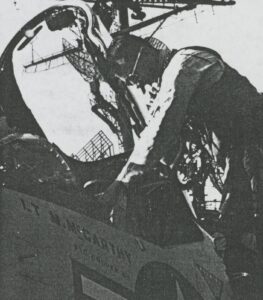
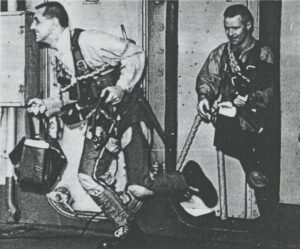
After the pilot preflights the plane, the plane captain follows the pilot up the ladder to strap him into the cockpit. The cockpit was very small and the pilot was loaded down with cumbersome gear. The pilot was wearing flight skins to keep him warm, his G-suit which when inflated it keep him from blacking out during high G force maneuvers. He carried his flight log in a pouch over one shoulder and a 38 calibre revolver in a bandolier over his other shoulder. The pistol was loaded ready for a parachute landing in enemy territory. The bandolier was packed with tracer ammunition as well as lead slugs for firing tracer rounds at search crews and slugs at the enemy. He sat on his life raft which would deploy at nine thousand feet along with his parachute. After strapping his pilot into the cockpit it was time for the plane captain to remove the safety pins in his ejection system in the cockpit. This system kept the ejection seat from firing until the pins were removed. There were also pins behind the seat that only the plane captain could reach. After climbing down the ladder the plane captain would show the pilot the pins displayed between his fingers and wait for the pilot to give him a thumbs up. Next the plane captain would close and lock the cockpit. Then the plane captain would remove the ladder put the pins along with the tie down chains in the chain bag hanging from the catapult hook. The huffer would arrive equipped with a small jet engine in back. The huffer driver would insert the pneumatic probe he carried on his tug. Then he would hook up the hose to the probe and signal the plane captain that he was ready. The plane captain would then signal the pilot the plane was ready to start the engine with a hand signal in a circular motion. The noise was so deafening it was impossible to talk, all communications had to be with hand signals. After the plane was started the plane captain removed the starting probe. Giving the pilot time to check his engine and other instruments he pulled the the pins in the landing gear, and tail hook, holding them displayed between his fingers until the pilot gave him a thumbs up. Next the plane captain signaled the pilot to move his ailerons, move his rudder, drop the tail hook, open & close the speed brakes and move his elevator up to the takeoff position after each move was completed he signaled the pilot with a thumbs up. Once all systems were checked the plane captain gave a salute to the pilot which he returned. At that point the plane captain would turn his plane with pilot over to the plane director. The plane captain would then put the chain bag with safety pins and eight tie down chains on his ladder, then wheel it through the mass of planes in various stages of staging for launch to the island secured it ready for his aircraft to return.The plane director would then guide the aircraft to the catapult. The catapult crew would hook up the bridle to the catapult hooks, then secure the plane to the deck with a breakaway connection located in the upper end of the planes tail-hook. The pit crew located in a pit next to the catapult would get the planes gross weight from the planes nose wheel and set the steam dials. He then signaled the catapult officer the correct steam pressure was dialed in. The catapult officer would then give the pilot a thumbs up indicating the catapult systems were dialed in. At that point the cat officer signaled the pilot to turn his engine up to 100% throttle, then waited for the pilot check his engine systems. If all his systems were a go the pilot would salute the cat officer and brace himself to be shot off the deck. The cat officer saluted the pilot, swept his hand towards the foredeck which was a signal to the bosn mate in the pits to fire the catapult. This was a force equal to being shot out of a cannon.
. In the fall of 1961 the USS Coral Sea departed Treasure Island, San Francisco CA, bound for Pearl Harbor, Hawaii. We arrived at Pearl Harbor just before Christmas. Upon our arrival at Pearl we were given a Hawaiian Flower Lei, a symbol of affection, love, respect, and honor. It was hard to believe that I was part of this. Less than a year since my enlistment, here I was a 19 year old kid from Mansfield MA, a plane captain on the flight deck of of an aircraft carrier bound for far away exotic ports of the western Pacific We enjoyed the holiday's drinking, swimming and surfing at the Army Fort on Waikiki Beach. The drinking age at the fort was 18 years old. The beer was ten cents and the surf boards were free. On an airman's wage of eighty five dollars a month, drinking at Fort DeRussy on Waikiki Beach was the best option. On Christmas I arranged to make a radio telephone call from the nearby submarine base. The base would use the single side band radio to call the marine operator in San Fransisco. She in turn would call my parents and connected us for a one way conversation with only one party at a time speaking. It was a snowy and cold day in Massachusetts on that Christmas day in Massachusetts, in Hawaii it was surfing weather in this island paradise. Not a bad place to be for a nineteen year old boy from a cold snowy New England town with a population of three thousand people.
 Prior to our final departure from this island paradise our flotilla would have to pass the "Operational Readiness Inspection" off the coast of Hawaii. This is a mandated comprehensive, grueling test of not only our abilities but the abilities of the entire flotilla to conduct war in the western pacific thousands of miles from homebase without the support of the vast resources we would have at home. The USS Coral Sea passed her ORI inspection with an E for efficiency. The E was proudly painted on our smokestack alongside of all the other E's she had earned since her launching in 1945. It was now time to return to Pearl Harbor where we would get our last taste of real milk or eggs in the shell for the duration of our deployment. In the pacific it would be sterilized milk, powered eggs and the Hula Girls. Neither the milk or eggs tasted anything like real milk or real eggs. The Hula girls would be nothing like the bar girls in the Philippines or other ports in the Pacific. It took a few days loading spare parts for the ship/aircraft, fuel for ship/aircraft, war surplus munitions for ship/aircraft, and stores for the crew! During our time at sea we would have to take on munitions, food and fuel from replenishment ships steaming alongside. We were most vulnerable while taking on stores via highline steaming slow keeping the cable tight. Our ship to ship replenishment operation were conducted at night to prevent detection which increased the hazards to the crew. There were times the cable would snap endangering or killing anyone in the way. Many a seaman have gone overboard during underweigh replenishments. In those days we were always followed by Russian fishing trawlers, which we could lose by temporarly increasing our ships speed to outrun them, then replenish. It wouldnt take long for them to be back on our track observing our operations.
Our next port of call was Subic Bay In the Philippines. In this port we had cinderella liberty which meant we had to be back on board the ship no later than midnight. Our liberty was confined to Olongapo Zambales, a small dirt road village adjacent to the navy base. This "skivvy" town as we called it was the exact opposite of my Hawaiian experience. There were only bars and one muddy road running through the village. No streets , no tourists just mud and the Jeepney's. They were a converted leftover WWII jeep with seats, an open air top with hanging pom pom balls. For food there was "Monkey Meat" stands near the entrance to the base. The only beer was San Miguel brewed at MacArthur breweries based in the Philippines. The choice of bar was not about the price of beer which was the same for all the bars. The quality control at the brewery was not very good, sometimes you would get falling down drunk on 3 beers another time you could drink three six packs just to get a good buzz. The choice of bar revolved around the girls that worked in the bars on the strip. Some bars had just girls the others had a mix of "Benny Boys" and girls. The old salts knew the difference. The cherry "boy-son" as the first timers were called soon found it wise to do a crotch test as this was the only way to ferret out who was who. The Philippine population are all fair skinned with no beard. Those of fair skin and slender build worked in the bars as Benny Boys to support their families. No different than the bar girls. Like the girls in the Wild West saloon, this was their job.
The support aircraft carrier USS Kearsarge LHD-3 was in Subic Bay at the same time. She was the , equipped with helicopters and Marines for vertical envelopment assaults, a never before attempted landing using helicopters in place of landing craft. This was a different contingent of marines than on our ship. Our marines guarded our Captain and our prisoners in the brig (jail). These were combat marines with only one thought, to engage and defeat the enemy. Needless to say there were many of muddy, bloody sailors returning to the Coral Sea at midnight. These shoreside bar-room battles would soon be forgotten in the big battle we were about to enter! We left Subic Bay, Philippines unexpectedly under cover of darkness at 0100 hours. We had no idea what or when our next port of call would be. Even the bar girls did not know we were departing that night. When we left Subic Bay were scheduled for another week in olongapo! So much for schedules!
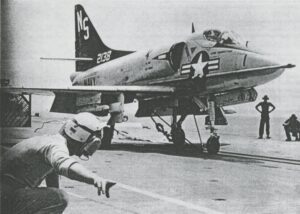 Arriving in the Gulf of Tonkin February 4th 1962, the USS Kearsarge LHD-3 made military history by landing the first contingent of US Marines on the shores of South Vietnam using helecopters in place of amphibious landing craft. We had personal in South Vietnam in the middle 1950's but this was the landing of combat marines to the shores of South Vietnam. Our job was to provide close air support to those Marines onshore. The real battle had begun, the battles of Olongapo Zambales were soon forgotten, as we had a job to do. The A4D Skyhawk was designed for close air support. My aircraft flew in the first wave of sorties from the deck of the Coral Sea. I was awarded the Armed Forces Expeditionary Medal for my participation in this initial action in Vietnam.
The scene of flight deck operations are similar to a macarbe ballet. The plane captains wore brown shirts, the plane directors wore yellow shirts, the plane pushers wore blue shirts, the deck crew wore green shirts etc. etc. all wore cloth helmets with "Mickey Mouse" bulging over each ear. The only sounds on the flight deck was the deafening roar of the jet engines. Yet to the officers in the wheelhouse coordinating this ballet of the men on deck all in perfect harmony, moving about the flight deck in synchrony was exactly what they had been trained to do.The night operations were even more macabre if that is possible. There is no white lights allowed anywhere on the ship at night. It takes about fifteen minutes to get your night vision. All compartments, passages and decks had red lights even in the bowels of the engine room many decks below the flight deck. The snipes kept our ship operating efficiently, taking care of the twelve boilers that made the steam to propel us. They desalted one hundred and fifty thousand gallons of water daily, for use in our catapults, boilers, drinking water at the scuttlebutts and all our fresh water needs. Without these men down in the bowels of the ship our ship would not be able tonight of survive a battle, There were times during days long operation they would not see the light of day for weeks. On the flight deck at night there was a big red light on the island casting a red glow over the flight deck. All the propeller aircraft ready for launch were stacked in rows on the ships fantail (rear). Their reciprocating engines need time to warmup whereas a jet engine could be started and launched by catapult almost immediatly. The propeller planes needed no catapult launch as the flight deck had sufficient length for them to lift off with a full load of bombs and fuel. They didn't fly fast but they carried their weight in bombs. The propeller planes were the last one to lift off the deck. They posed an ever present danger with their propeller which even with the engines at idle they were deadly. You could feel the heat from the jets exhaust as they were moved onto the catapults. With the propeller planes at night you could see the planes running lights blinking but it was hard to differentiate all the blinking lights, nor could you feel the wind from their propellers. You knew where they were and did everything in your power to stay on your feet to avoid them.The exhaust from the jets was always waiting to burn you, or toss you like a rag doll overboard or tumbling down the deck into the waiting propellers. When the jets were moving onto the catapults the pilot had to give them a lot of throttle to begin their movement. The fighter planes had clamshell exhaust for instant acceleration in a dog fight. They were always the first off the decks to supply fighter cover while we were launching the bombers. In order to gain initial movement when you gave the engine throttle to move the plane on a rolling, pitching deck the clam shell would close, if the exhaust hit with the clamshell closed it could pick you up and propel you overboard or into the waiting propellers on the aft deck and of course the wind careening down the deck did not help.. My initiation into the clamshell exhaust propelled me to within inches of going overboard. Needless to say I never had my head up my ass again. After that close call my head remained on a swivel 24/7, as a matter of fact it still does to this day, it's named Post Traumatic Stress Disorder. In sailors terms it's called FUBAR (fucked up beyond all repair). The other factor to consider is the twenty five to thirty five knots of wind roaring down the the deck. The wind coming over the deck was necessary to assist the heavy bomb laden aircraft aloft. Landing at night was a whole different story. We think of an aircraft carriers as enormous but looking at the ship from the air it is merely a speck, something like a postal stamp floating in the water. The pilots had a Mirror Landing System and a Landing Signal Officer to assist them in landing. In the end it was pilot ability to put his aircraft in the middle on the mirror called the meatball. Planes would occasionally hit the roundown on the ships stern coming in to low, sending parts and pieces careening up the deck. Not all debris went off the angle deck, it would find its way up the straight deck where the planes were being loaded with munitions for their next mission but that is a blurb all to itself. After landing the plane the pilot would lift the tail hook to clear the arresting gear wire and taxi the aircraft to the straight deck to be turned around for the next mission. The Blue shirts chocked the plane wheels.The plane captain hung the chain bag back on the catapult hook. He would then remove three tie down chains putting their hooks in their padeyes in the deck, then inserted the ladder into the plane. He climbed the the ladder, installed the safety pins, unbuckled the pilots harness and helped the pilot out of the cockpit. If the pilot signaled for the trouble shooter of a big problem, the trouble shooter would make a determination wether the plane went down the elevator to the hanger deck or could be fixed by the plane captain and turned around for the next mission. It was a good feeling to have my plane back.As soon as I got a relief to ride the brakes if they had to move the plane, it was off to the ready room to see if the pilot had any gripes during his mission. It was the plane captain's responsibility to fix malfunctions prior to the next mission. His plane now had to be fueled, oil for the engine, loaded with munitions, liquid oxygen tank filled, preflighted for the next mission and then the gross weight applied to nose wheel. In the ready room he would write the gross weight in the log book and sign the log book that his plane was ready, fueled, liquid oxygen and munition ready for the next pilot to take his airplane into harms way. There were occasions when we conducted flight operations for more than four days, twenty four hours a day in support of our Marines on the shore. When we were in port fights broke out between the Navy and Marines, when it came time to battle we worked harmoniously as one unit ready to win the battle. While his plane was flying on a mission a plane captain could sit in the ready room and listen to the Marines calling in airstrikes from his pilot. We lost far more crew members on the flight deck in the early phases in the war because the enemy had very little anti aircraft guns in South Vietnam. It was different in later years when we started flying missions over North Vietnam where anti aircraft guns and enemy fighter planes played a big part in our losses of our planes and pilots.